
Overview:
Oblatio is a work-in progress as a transmedia research pipeline exploring how more traditional literary symbolic narrative forms may be translated into immersive systems.
This practice aims to develop a cross-media methodology in which symbolic narrative structures are generated, formalised, and translated into immersive environments, enabling the systematic investigation of how aesthetic form modulates perception, affect, and meaning.
Month: December 2025
Media: Speculative fiction.
PhD Stage: Year 2
Key Themes: Magical realism, world-building, internal consistency, sub-creation
Category: Research Practice
Research Question: How can immersive environments be composed to support awe and transformative reflection?
Project Strand: Oblatio – Exploring Immersion in literature and symbolism
Output: Story/Symbolism development, reflective documentation, dissemination platform
Practice Focus
Oblatio is a work-in progress as a transmedia research pipeline. This practice in broad terms aims to develop a cross-media methodology in which symbolic narrative structures are generated, formalised, and translated into immersive environments, enabling the systematic investigation of how aesthetic form modulates perception, affect, and meaning.
The research focus of this phase is the development of narrative techniques that allow a story to operate simultaneously at personal, collective, and ecological scales – ‘a legible we’. I am provisionally calling it transpersonal legibility: a mode of fiction in which motives, ruptures, and shifts become readable at scales beyond the individual self,
I am exploring the importance of speculative fictions and how effectively emerging immersive media can function for delivering meaningful stories. To do this, I needed my own story. Fortunately I have been driven by a series of captivating visions and stories that won’t let me go until I write them down. From here I have a ‘canon’ of thematic material I can experiment with in immersive forms to see how they can structure attention, affect, and world-experience.
Experiments / Iterations / Process Notes
I have been returning repeatedly to the manuscript across changing moods, days, and states of attention in order to gain critical distance from the writing. I worked by testing whether a passage had become atmospherically and sensorially alive : can I ‘feel’ the wind, ‘smell’ the petrichore, or ‘hear’ the waterfalls? Can I sense a world running between the words of the text. Is it good enough to hypnotise me, and if so, is it good enough to work that way for someone else? This will have to wait until I can create a form I can easily distribute.
- Repeated returns under different states of perception
- Revision through temporal distance (taking breaks)
- Sensing atmospheric and imaginal depth credibility
The iterative work therefore consisted in re-entering, paring back, and recalibrating passages whose symbolic or imaginal life had not yet fully opened. Its not like building a rocket where if it blows up you can study the metrics and stress points and iterate the design. You don’t know in any given area what is a pass or a fail, what reaches the reader or what doesn’t.
These heuristics emerged directly through writing and revision. They function both as compositional tools and as analytical lenses for reading.
- Read for operations, not outcomes.
Ask what the scene is doing: dissolving, separating, recombining. Treat narrative as process rather than result. (Jung) - Track role ecology.
Which roles are active? How do their recombinations alter what becomes possible? Follow the system, not the individual alone. (Hillman) - Watch affordances.
What does the environment allow or forbid? What actions become newly possible or impossible? Treat setting as a field of constraints and permissions. (Gibson) - Notice infrastructure when it fails.
When systems break, what hidden structures become visible? What implicit beliefs or distributions of power are revealed? (Star; Latour) - Feel the phases.
Distinguish between cooling, warming, and integration. Not all transformation is fusion; some requires separation, clarification, or delay. (Alchemy; Lurianic repair)
These heuristics formalise aspects of the writing process that were initially intuitive. They now provide a method for both composing and analysing immersive symbolic narratives.
Artefacts / Documentation
- revised manuscript passages
- annotated notes on symbolic sequencing
- observations on awe, authority, and reintegration
- candidate source material for later VR / spatial adaptation
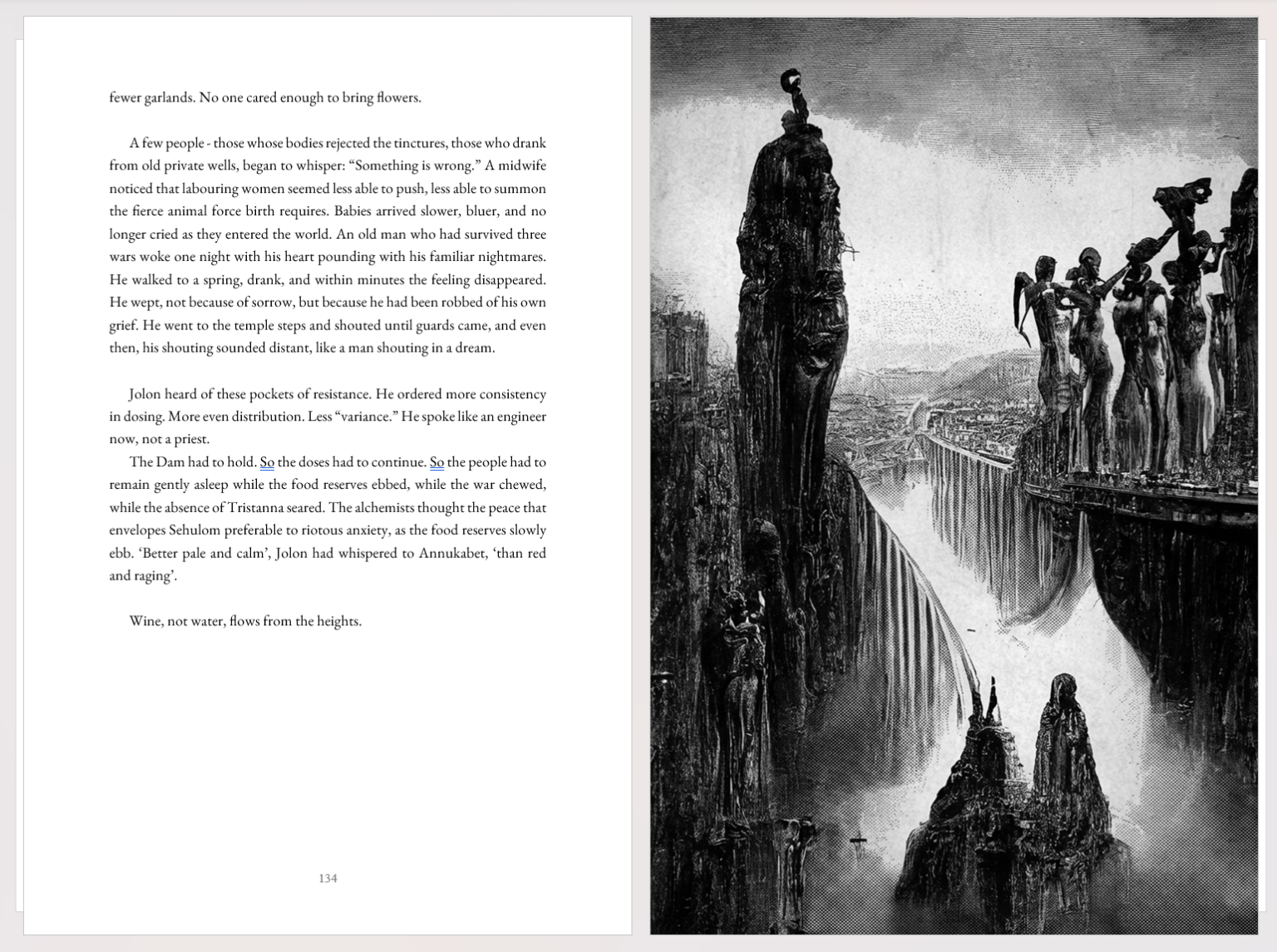
The principal artefacts generated during this phase include revised manuscript sections of Oblatio, annotated drafts, structural notes on scene sequencing, and written reflections on symbolic and narrative form. These materials document the movement from earlier, more overtly interpretive passages toward subtler and more integrated forms of symbolic narration.
Documentation from this stage includes iterative versioned chapter drafts, notes on recurring motifs and their transformations, comparative revisions of passages where symbolic density was either increased or reduced, and reflective writing articulating the emerging concept of transpersonal legibility.
Critical Reflection
The concept of transpersonal legibility emerged through the compositional struggle of aiming for ‘a legible we’. It has been a process marked by iterative honing3.
Transpersonal legibility doesn’t deny the individual; it situates the person inside patterns that outlast them. Effective symbolic fiction does not need to announce its governing forms. It lets them operate beneath the visible surface of the text. By hiding alchemical geometries in the motion of the text, distilling figures to roles with care, and letting ecology report the psyche, the story becomes a training in perception. Tikkun – ‘rectification’ – is a different epistemology than revelation or act of heroic redeption but a rhythm of integration and harmonisation.
There are caveats to the ambitions here. Myth seems to have a collective, chthonic quality that is woven out of ‘journeys of a people through time’. There have been contemporary examples of speculative fictions and fantasies that have the scope of mythic quality. Tolkien had much to comment on how this may come about through certain forms of creative orientation, which I have been keeping in mind. And yet it is hard to structure a ‘myth’ top-down, which is why I’m leaning into the ‘egregore’ (collective field) and zeitgeist (spirit of the times).
Research Development
Literature functions as a low-apparatus but high-resolution testbed for immersion. Awe can be generated without sensory immersion, through symbolic structure alone. This is evidentiary through the history of poetry and literation. It doesn’t involve audiovisual enclosure and interactivity, but it still involves states of focussed attention and contemplative absorbtion, as well as deepened internal horizons.
Chirico1 describes what awe feels like and when it happens.
What is forming through practice is a parametric model of how to generate those conditions, a design-control surface2.
One emerging proposition : that immersion and attention capture are concomitant of most art-forms, rather than something specific to algorythmic platform cature, must be reflected in the formation of the nascent ‘Immersion Intensity and Plasticity Scale’ (IIPS). IIPS needs to be medium-agnostic not just a VR framework. Whilst existing research demonstrates that awe can be induced through perceptual vastness and novelty, we could extend that claim by showing that awe can also be structured through symbolic, narrative, and ecological patterning, even in the absence of high-intensity sensory immersion.
| Chirico Principle | IIPS Variable (in progress) | Expanded System |
|---|---|---|
| Vastness | E (Envelopment) + I (Internal Horizon) | scale, symbolic resonance |
| Accommodation | Fr (Framing) + T (Thresholds) | sub-visible structure, thresholds |
| Self-diminishment | E (Envelopment) + I (Internal Horizon) | ecological agency, archetypal depth |
| Emotional complexity | I (Internal Horizon) | symbolic resonance / archetypal depth |
| Lasting impact | R (Reintegration) | narrative residue, community aftercare |
Dissemination / Practice Ecology
The near-completion of manuscript development initiates expansion into immersive form.
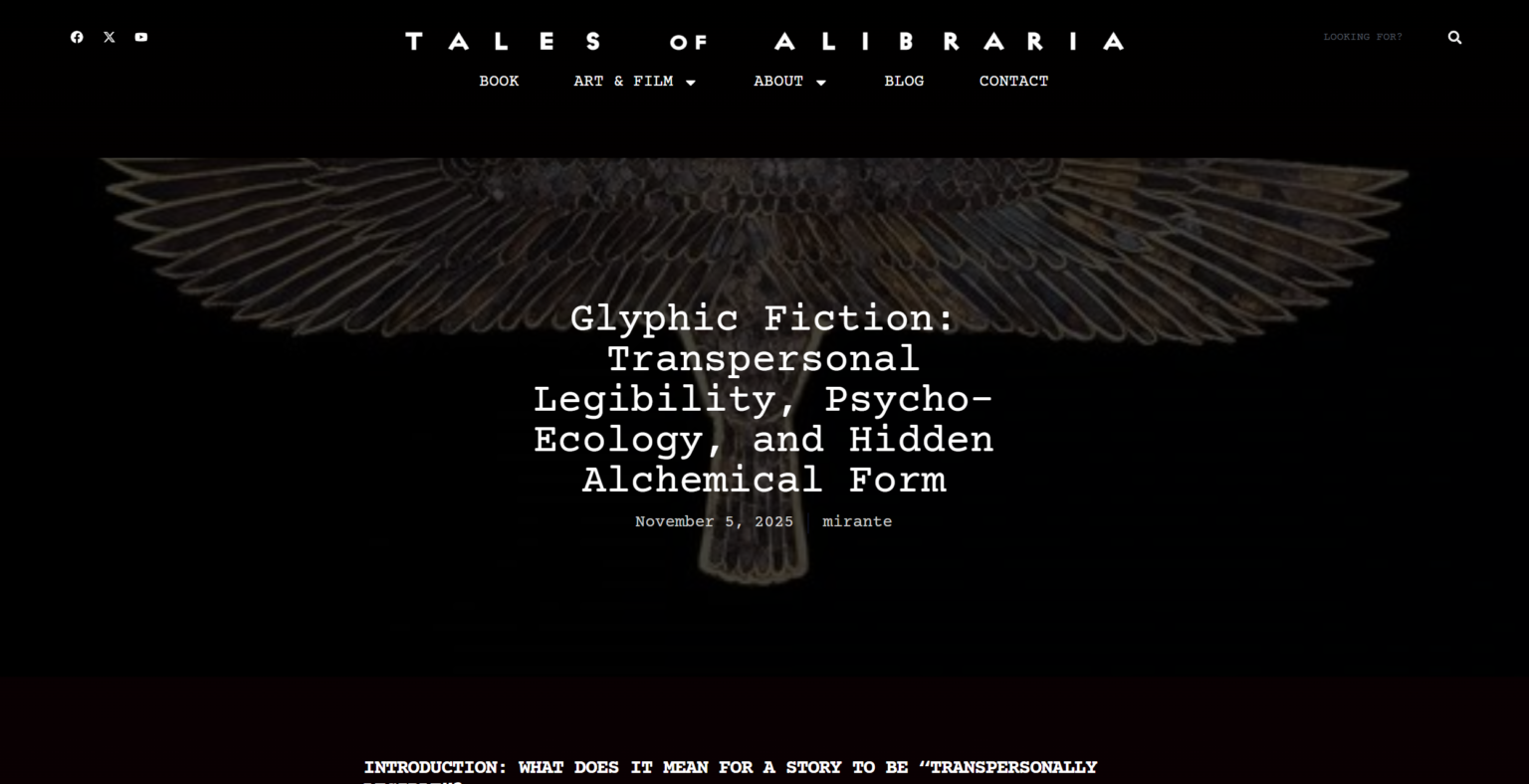
www.talesofalibraria.com functions as an active research interface (combined with promotional hub).
The platform records the translation of narrative and symbolic structures from Oblatio into immersive, spatial, and computational forms. Posts articulate emergent frameworks that arise directly from the creative investigation.
The blog operates as a public-facing layer of practice-based methodology, documenting how symbolic systems migrate across media and how immersive environments can be constructed from narrative primitives.
Feedback / Peer Exchange
[ SYMBOLIC GENERATION ]
↓
[ CONCEPTUAL FORMALISATION ]
↓
[ IMMERSIVE INSTANTIATION ]
↓
[ EXPERIENCE + FEEDBACK ]
↓
[ REFINEMENT OF SYMBOLIC SYSTEM ]
↺ (loop)
Next Steps
I’m aiming to complete the novel by new year and push it to Amazon KDP so that I can field a large feedback pool to how the work is recieved based on the principles I’ve pursued. Meanwhile I will work on the development of transmedia digital immersive forms to see how book material could find translation.
Footnotes
- This framing draws on research into awe, liminality, and immersive design as conceptual anchors for understanding how aesthetic environments may shape attention and perception. ↩
- The distinction here is between immersive media as a technical platform for delivering content and immersive media as a designed condition of perception in which framing, transition, and orientation become central compositional concerns. ↩
- This aligns with reflective-practice and research-through-design approaches in which knowledge emerges through iterative engagement with materials, processes, constraints, and situated decisions. ↩
Bibliography
- C. G. Jung, Mysterium Coniunctionis, in Collected Works of C. G. Jung, vol. 14 (Princeton, NJ: Princeton University Press, 1970).
- Jody Myers, “Kabbalah at the Turn of the 21st Century,” in Jewish Mysticism and Kabbalah: New Insights and Scholarship, ed. Frederick E. Greenspahn (New York: New York University Press, 2011), 175–190.
- Lawrence Fine, “The Contemplative Practice of Yihudim in Lurianic Kabbalah,” in Jewish Spirituality: From the Sixteenth-Century Revival to the Present, ed. Arthur Green (New York: Crossroad, 1987), 49–73.
- James Hillman, Re-Visioning Psychology (New York: Harper & Row, 1975).
- Victor Turner, The Ritual Process: Structure and Anti-Structure (Chicago: Aldine, 1969).
- James J. Gibson, The Ecological Approach to Visual Perception (Boston: Houghton Mifflin, 1979).
- Donella H. Meadows, “Leverage Points: Places to Intervene in a System” (Hartland, VT: Sustainability Institute, 1999).
- Susan Leigh Star, “The Ethnography of Infrastructure,” American Behavioral Scientist 43, no. 3 (1999): 377–391.
- Jane Bennett, Vibrant Matter: A Political Ecology of Things (Durham, NC: Duke University Press, 2010).
- Bruno Latour, We Have Never Been Modern (Cambridge, MA: Harvard University Press, 1993).
- Timothy Morton, Hyperobjects: Philosophy and Ecology after the End of the World (Minneapolis: University of Minnesota Press, 2013).
- Timotheus Vermeulen and Robin van den Akker, “Notes on Metamodernism,” Journal of Aesthetics & Culture 2, no. 1 (2010): 1–14.
- Jan Assmann, “Communicative and Cultural Memory,” in Cultural Memory Studies, ed. Astrid Erll and Ansgar Nünning (Berlin: de Gruyter, 2008), 109–118.
Tags: #immersivemedia #practicebasedresearch #VR #awe #ritualaesthetics #spatialaudio #worldbuilding #doctoralresearch