
Overview: Publication of Oblatio through Amazon KDP, which establishes the literary work in a fixed and public form and gives me public feedback as a basis of whether my speculative fiction resonates with readers. From here, opening a new line of immersive experimentation through gaussian splat development based on AI-generated environments.
Month: January 2026
Media: Speculative fiction, generative video, environment composition, gaussian splats
PhD Stage: Year 2
Key Themes: Awe, liminality, ritual aesthetics, spatial presence
Category: Research Practice
Research Question: How can immersive environments be composed to support awe and transformative reflection?
Project Strand: Oblatio Transmedia Project
Output: Book Publication, Prototype development and reflective documentation
Practice Focus
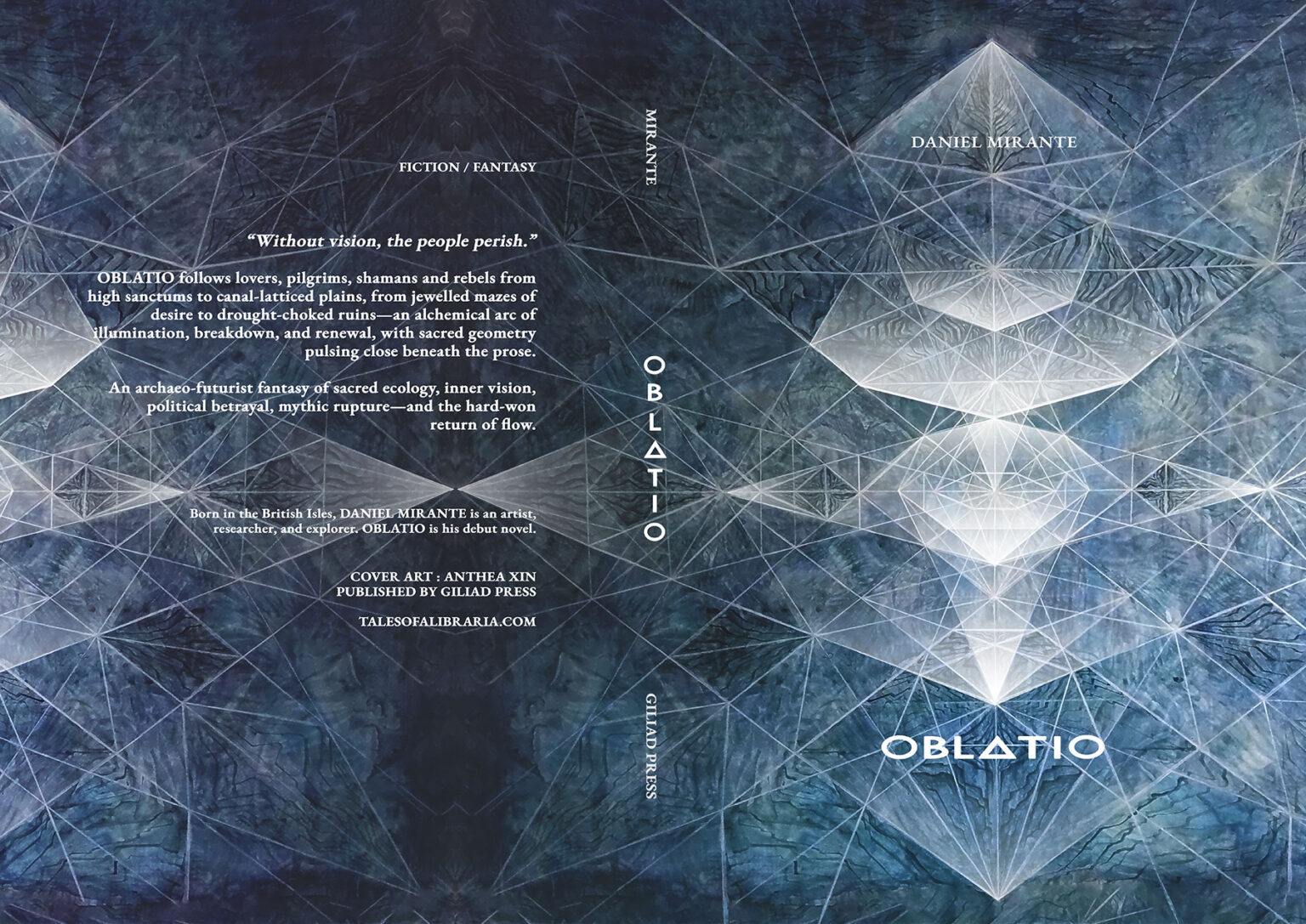
January marks a threshold between private craft, public publication and spatial unfolding. Oblatio is available now in public form through Amazon KDP.
I begin to press further outward into volumetric experiment. The focus of this period is the question of whether AI-generated image-worlds can be given greater persistence: not appearing as transient visions or animated surfaces, but taking on enough depth and stability to become reusable sets for immersive cinema, live-action compositing, theatre, and later spatial translation.
Emerging research has shown that Gaussian splatting can function as a fast explicit 3D scene representation, and that generative systems are beginning to be coupled to splat-based scene creation rather than remaining confined to flat image or video output. (GitHub) In the context of Oblatio (and now, the next speculative fiction cycle, Ziggurat), this opens the possibility that symbolic and speculative environments need not vanish after each generation cycle. They may instead persist as scene-forms: inhabitable visual structures that can be returned to, filmed within, combined with green-screened bodies, and developed further inside real-time engines. The research focus of this phase, then, is not only technical experimentation, but the search for a more durable bridge between visionary image-making and immersive world-construction. (arXiv)
Experiments / Iterations / Process Notes
Book Publication
Amazon KDP is a low-bar of entry, easy access method of mass distribution publication. My aim was to push the finished work out into a format that is cheap and international – preferencing ‘pulp’ formats over expensive premium book-printing. I am not spending much effort promoting it, but I wanted to finalise its existence and form as a media object as I require feedback on how well the writing connects to people.
Gaussian Splat Models from Generative AI Film
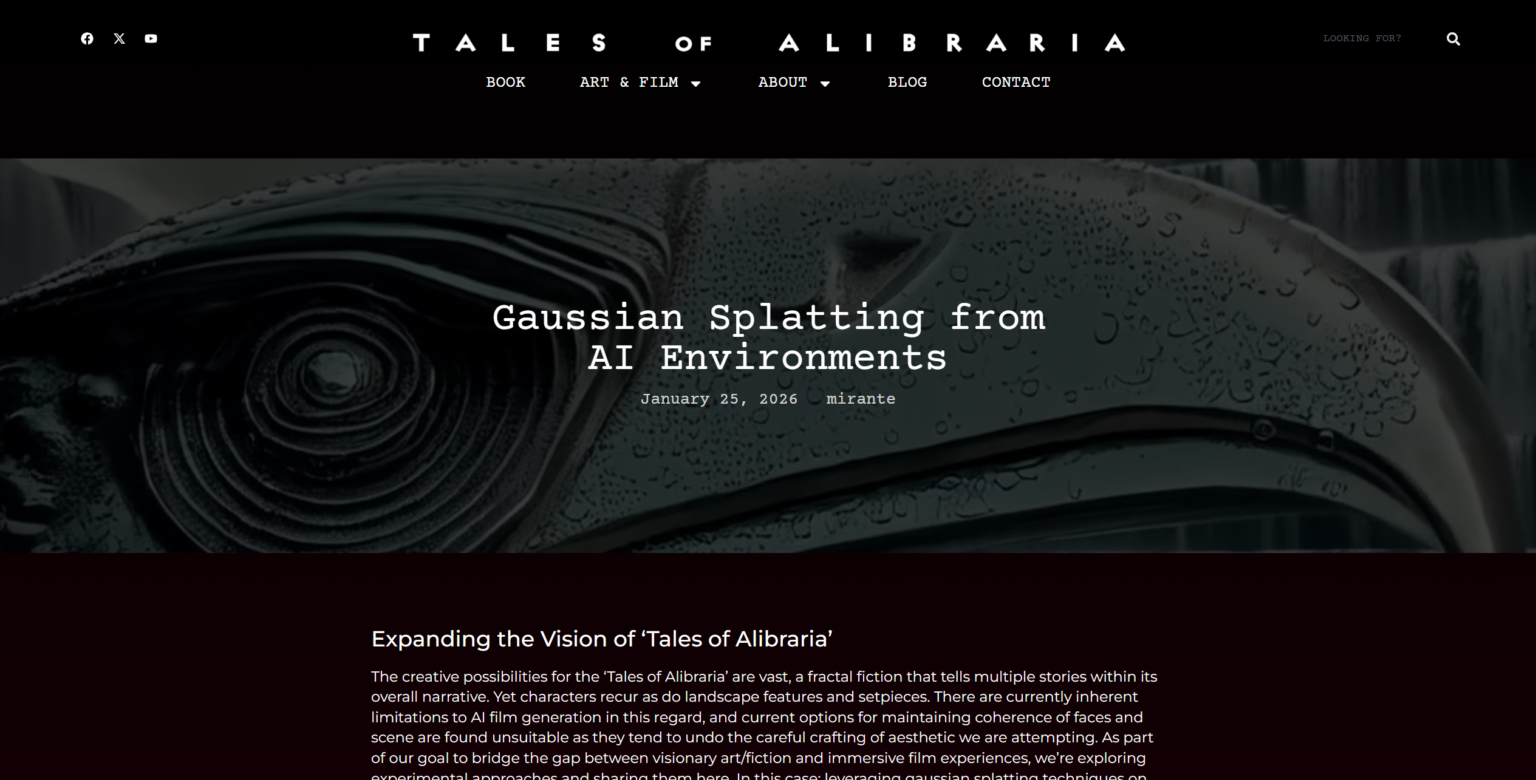
Opening of a new line of immersive experimentation through gaussian splat development based on AI-generated environments. The splat work began from a practical and aesthetic question: whether image-based and generative environments could be given greater volumetric persistence, allowing them to move beyond flat animation toward more inhabitable spatial form. Initial experiments explored how AI-generated scenes might function not only as images or animation substrates, but as the basis for spatial reconstruction and later immersive filmmaking.
Although still exploratory, this marked an important shift. The project began to move from the translation of symbolic material into moving image toward the possibility of scene-worlds with greater depth, continuity, and spatial presence.
Variable tested: Can gassian splatting interpret generative scenes as if they were real 3d scenes?
Method: Generated a variety of scenes with different perspectives, depths, complexity and ran through Postshot software to process gaussians.
Provisional finding: The current generation of AI film generators lack precise enough spacial consistency and solidity to produce anything more than evocative and picturesque results. Would require significant post editing in Unreal Engine or else use them for deep field backgrounds that do not require high fidelity.
Implication: The potentials for theatre, performance or video performance backgrounds remains compelling.
Artefacts / Documentation
The principal artefacts from this period include the published Amazon KDP edition of Oblatio and the first development materials related to gaussian splat experimentation from AI-generated environments. These include source images, early test outputs, workflow notes, and public-facing reflections on the Tales of Alibraria website.
The website also functions as a dissemination and documentation layer, recording the project’s movement from literary and symbolic development toward immersive and volumetric experimentation.
Critical Reflection
What interests me here is the prospect that such imagery may be stabilised into reusable scene-forms that can be returned to, filmed within, combined with live-action performance, and developed further in immersive pipelines.
At the same time, this remains an open and difficult problem. The current results are exploratory, and it is not yet clear how much aesthetic coherence, symbolic precision, and practical usability can be preserved through this process. The danger is that the method may yield technically intriguing outputs without sustaining the mythic charge or formal integrity the project requires. January therefore revealed less a solved method than a more exact research problem: how to move from generated apparition to durable world.
Research Development
Dissemination / Practice Ecology
I have shared a novel & written up my early experiments with gaussian splatting from generative video.
www.talesofalibraria.com functions as an active research interface (combined with promotional hub).
The platform records the translation of narrative and symbolic structures from Oblatio into immersive, spatial, and computational forms. Posts articulate emergent frameworks that arise directly from the creative investigation.
The blog operates as a public-facing layer of practice-based methodology, documenting how symbolic systems migrate across media and how immersive environments can be constructed from narrative primitives.
Feedback and Peer Exchange
This work was an introverted month concerned mainly with completion and public launch of the speculative fiction and experimenting with gaussian splatting.
Next Steps
Next month I intend to develop the strongest current environment into a more resolved experiential sequence, with particular attention to transition design, symbolic restraint, and the relation between visual scale and sonic enclosure. I visualise a development of steadily more immersive methods – from scene consistency (gaussians) to 3d (SBS), to 360 or 180 degree environments, to spacial audio.
Footnotes
- Victor Turner, The Ritual Process: Structure and Anti-Structure (Chicago: Aldine Publishing, 1969) remains a seminal source text for liminality, threshold structures, transformation
- Dacher Keltner and Jonathan Haidt, “Approaching Awe, a Moral, Spiritual, and Aesthetic Emotion,” Cognition and Emotion 17, no. 2 (2003): 297–314 is a canon text for for awe as vastness + need for accommodation
- Susan Leigh Star, “The Ethnography of Infrastructure,” American Behavioral Scientist 43, no. 3 (1999): 377–391. Her work concerns infrastructure, breakdown, visibility, persistence
Bibliography
Chirico, Alice, and David B. Yaden.
2022. “Awe: A Self-Transcendent and Sometimes Transformative Emotion.” Current Opinion in Psychology 45: 101271.Chirico, Alice, et al.
2017. “Virtual Reality and Awe: Exploring the Potential of Immersive Technologies to Elicit Awe.” Frontiers in Psychology 8: 2351.Grau, Oliver.
2003. Virtual Art: From Illusion to Immersion. Cambridge, MA: MIT Press.Hartogsohn, Ido.
2023. “The Cyberdelic Turn: Psychedelics, Virtual Reality, and the Quest for Transcendence.” Frontiers in Virtual Reality 4: 1135933.Keltner, Dacher, and Jonathan Haidt.
2003. “Approaching Awe, a Moral, Spiritual, and Aesthetic Emotion.” Cognition and Emotion 17 (2): 297–314.Latour, Bruno.
1999. Pandora’s Hope: Essays on the Reality of Science Studies. Cambridge, MA: Harvard University Press.Star, Susan Leigh.
1999. “The Ethnography of Infrastructure.” American Behavioral Scientist 43 (3): 377–391.Turner, Victor.
1969. The Ritual Process: Structure and Anti-Structure. Chicago: Aldine Publishing.
Tags: #immersivemedia #practicebasedresearch #VR #awe #ritualaesthetics #spatialaudio #worldbuilding #doctoralresearch