
Overview: This month brings a shift in how awe is understood within the project, moving from a generalised positive concept toward a more structurally and ethically complex phenomenon. Work on Politics of Consciousness and Immersive Media is focusing attention on how awe operates across ritual, temple art, political spectacle, and immersive systems. Across the case studies, awe widens perspective, dissolves prior certainties, and supports transition within liminal sequences (Turner 1969; van Gennep 1960). Awe also intensifies deference, consolidates alignment, and stabilises authority through symbolic and affective capture (Gell 1992; Debord 1967). The consequences of awe vary according to how experiences are structured, framed, and integrated.
This is clarifying a design problem. Intensity does not determine outcome. The structure of the experience shapes whether awe deepens autonomy, reinforces passivity, or binds the participant to an externally authored frame.
Month: October 2025
Media: Literature review, research, thought experiments
PhD Stage: Year 2
Key Themes: Awe, liminality, dual use, dark patterns
Category: Research Practice
Research Question: How can immersive environments be composed to support awe and transformative reflection?
Project Strand: Theory and concept
Output: Peer reviewed published paper
Research
The primary activity this month is the development of a comparative essay as a research method. Writing is used to place ayahuasca ritual, Egyptian temple environments, avant-garde experimentation, fascist spectacle, and contemporary immersive media into a shared analytical field. The aim is to examine how different systems construct experiential worlds and organise meaning within them.
Ayahuasca ritual demonstrates structured transformation shaped through set, setting, symbolic density, and guided navigation (Shanon 2002; Metzner 2006). Egyptian temple environments demonstrate immersive symbolic totality aligned with cosmology and state order (O’Connor 2009; Eliade 1959). Fascist spectacle demonstrates the use of scale, synchrony, and symbolic intensity to produce collective identification (Debord 1967; Taylor 1974). Contemporary VR research demonstrates controlled induction of awe through perceptual manipulation and presence (Chirico et al. 2018; Quesnel and Riecke 2018).
Placing these cases in relation reveals continuity in how immersive environments shape belief, orientation, and collective alignment across different technological substrates.
Practice
n/a
Experiments and Iterations
The experiments this month are conceptual and comparative. One line of enquiry examines how similar intensities of experience produce different outcomes. Ritual environments include preparation, symbolic orientation, ordeal, and reintegration. Spectacular environments deliver scale and sensory intensity with minimal integration. Both induce awe. The outcomes differ in durability, interpretation, and behavioural consequence (Turner 1969; van Gennep 1960; Debord 1967).
A second line of enquiry examines how meaning is assigned. In some environments, participants interpret their experience within shared symbolic frameworks. In others, meaning is pre-authored and delivered through institutional or media structures. Awe correlates with increased alignment in highly framed environments, particularly where authority is embedded in the experience (Keltner and Haidt 2003; Gell 1992).
A third line of enquiry introduces a hypothetical scenario: a large-scale immersive event designed to cultivate ecological orientation and collective responsibility. The scenario tests whether technologically mediated awe can support reflection and integration at scale without collapsing into spectacle or passive absorption. This remains an open question.
Artefacts and Documentation
The principal artefact is the essay Politics of Consciousness and Immersive Media. It assembles case studies across ritual, architecture, spectacle, and immersive media to examine how awe operates as a mechanism of epistemic change and social organisation.
Supporting materials include comparative notes on sacred and spectacular configurations, annotations on context and framing, and working distinctions related to transformation, alignment, and integration. These materials document a shift in the project from thematic exploration toward structural analysis.
Technical and Process Notes
This month shifts attention toward compositional variables that shape immersive experience. Frame, sequencing, authority, and integration are becoming central.
Frame defines how the experience is interpreted (Bell 1992). Sequencing organises entry, intensification, and return (van Gennep 1960). Authority determines how meaning is assigned within the experience (Gell 1992). Integration determines how effects persist beyond the event (Turner 1969).
The analysis shows that sensory intensity does not stabilise meaning. Meaning is assigned through symbolic structure, narrative framing, and institutional context. This is beginning to influence how immersive design is approached within the project.
Critical Reflection
The central pressure this month is ethical. Awe reorganises cognition and opens the subject to new scales of meaning. That same plasticity creates risk. Systems that induce awe can support transformation, connection, and renewed agency. They can also produce submission, dependency, and passive absorption (Gell 1992; Debord 1967; Keltner and Haidt 2003).
The darker side of the material is becoming difficult to ignore. Ritual contexts show how transformation can coexist with manipulation and interpersonal power. Monumental and political environments show how symbolic immersion can bind cosmology to hierarchy. Commercial immersive media show how transcendence can be packaged as spectacle, delivering intensity without context or integration. These patterns indicate that immersive design carries its own forms of dark pattern: exploitation of cognitive yielding, capture of attention, and pre-authoring of meaning.
This shifts the question. The issue is no longer how to produce awe, but how to work with it without reducing the participant to a subject of control. This brings focus to framing, authority, interpretive freedom, and reintegration. Outcomes depend on whether an experience strengthens autonomy and meaning-making, or redirects them toward externally authored structures (Turner 1969; Bell 1992).
The month therefore clarifies a direction. Human-positive immersive art requires greater literacy in how powerful states are structured and held. Context, interpretation, and return become part of the work itself. The aim is not to avoid intensity, but to organise it in ways that support participation in life rather than passive enthralment.
Contribution to Doctoral Research
This month is clarifying the project’s core problem and giving it a more legible research form. Awe is no longer sitting in the work as a broad experiential interest. It is emerging as a site where epistemic change, symbolic framing, and political power converge. The comparative work across ritual, temple art, spectacle, and immersive media is narrowing the research toward a more exact question: how do designed experiences reorganise perception and agency, and under what conditions do those reorganisations support transformation, alignment, or capture?
This line of enquiry is also beginning to leave the level of private working notes and take on a publishable form. The Politics of Consciousness and Immersive Media: An Integrative Review is published in Art&Sensorium in July 2025, which gives the work an external and peer-reviewed presence while also confirming that this area of investigation can stand as a serious contribution in its own right. The publication matters methodologically as well as professionally. It consolidates the argument that immersive systems can be studied as architectures of epistemic transformation, and that any account of immersive media which ignores consciousness, symbolism, and power remains incomplete.
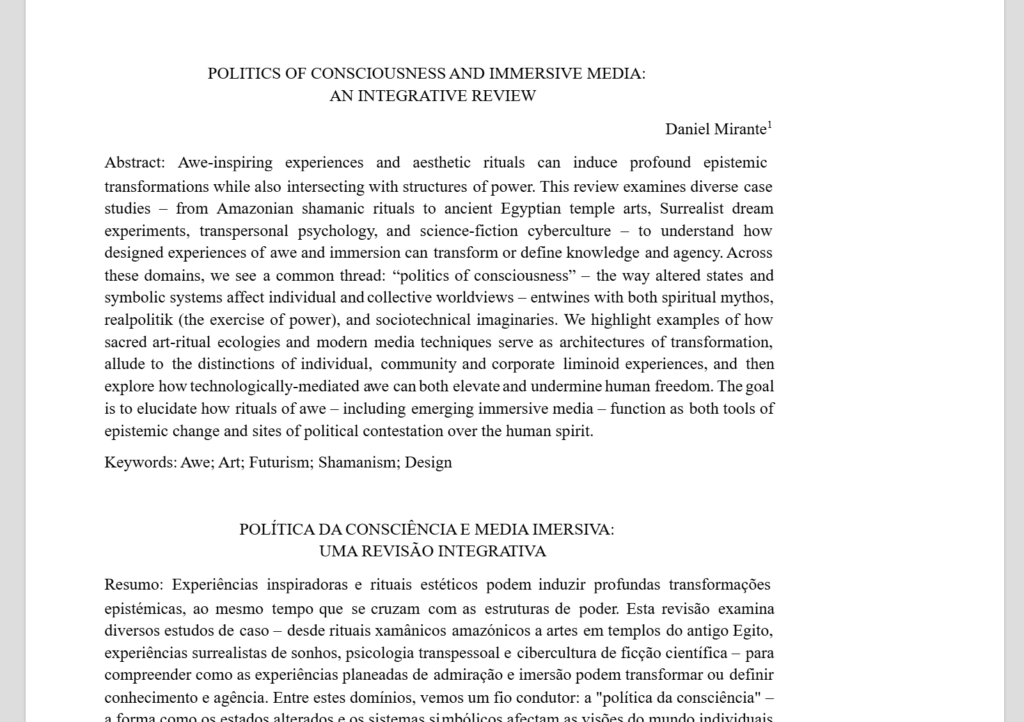
The Politics of Consciousness and Immersive Media: An Integrative Review
July 2025 Art & Sensorium 12(01):1-14
DOI:10.33871/sensorium.2025.12.10951
License CC BY 3.0
Feedback and Peer Exchange
n/a
Next Steps
The next phase focuses on the structural conditions that differentiate forms of immersive experience. Key areas include framing, sequencing, authority, and integration.
Questions emerging from this month include:
- how framing shapes interpretation
- how sequencing supports transformation
- how integration stabilises experience
- how authority operates within immersive systems
This month ends with a clarified problem and a more precise direction for further research.
Footnotes
n/a
Bibliography
Arthurs, Joshua. 2012. Excavating Modernity: The Roman Past in Fascist Italy. Ithaca, NY: Cornell University Press.
Bell, Catherine. 1992. Ritual Theory, Ritual Practice. New York: Oxford University Press.
Chirico, Alice, and David B. Yaden. 2018. “Awe: A Self-Transcendent and Sometimes Transformative Emotion.” In The Function of Emotions, 221–233.
Chirico, Alice et al. 2018. “Designing Awe in Virtual Reality.” Frontiers in Psychology 8: 2351.
Debord, Guy. 1967. La Société du Spectacle. Paris.
Gell, Alfred. 1992. “The Technology of Enchantment.” Oxford.
James, William. 1902. The Varieties of Religious Experience. New York.
Keltner, Dacher, and Jonathan Haidt. 2003. “Approaching Awe.” Cognition and Emotion 17 (2): 297–314.
Metzner, Ralph. 2006. Sacred Vine of Spirits. Rochester, VT.
O’Connor, David. 2009. Abydos. Cairo.
Quesnel, David, and Bernhard Riecke. 2018. “Are You Awed Yet?” Frontiers in Psychology 9.
Shanon, Benny. 2002. The Antipodes of the Mind. Oxford.
Taylor, Brandon. 1974. Art and Literature Under the Bolsheviks. London.
Turner, Victor. 1969. The Ritual Process. Chicago.
van Gennep, Arnold. 1960. The Rites of Passage. Chicago.
Tags: #immersivemedia #practicebasedresearch #VR #awe #ritualaesthetics #spatialaudio #worldbuilding #doctoralresearch