
Overview: Focusing on the iterative development of immersive environment prototypes. Examining how atmosphere, spatial scale, threshold imagery, and sonic enclosure shape the transition from ordinary attention into states of contemplative absorption, awe & liminality within virtual environments. A nascent format-agnostic immersion framework has been developed and examined via peer review by the XR community.
Month: March 2026
Media: VR, generative video, 360 degree 3D SBS video, environment composition
PhD Stage: Year 2
Key Themes: Awe, liminality, ritual aesthetics, spatial presence
Category: Research Practice
Research Question: How can immersive environments be composed to support awe and transformative reflection?
Project Strand: 360 degree stereoscopic VR prototyping
Output: Film rushes. Research paper & Presentation on the Immersion Intensity & Plasticity Scale.
Practice
How can symbolic and mythic forms be translated into immersive artworks that function as threshold experiences, and what compositional and ethical conditions appear to support absorption, awe, and reintegration within those works?
The process is focusing on additive layers of immersion. I have achieved 360 degree film with a combination of generative media, gaussian splatting, and unreal engine. Now I must look into making it stereoscopic so the depth panoramas have illusionary depth. There are further layers to impliment beyond these, such as spacial audio.
Experiments and Iterations
Developing bespoke work pipelines to achieve 360 degree, stereoscopic panoramas that can have long immersive scene lengths.
Artefacts and Documentation
360° Immersive Video Rushes
Scenes are getting longer. I am able to produce long passages of continuity and more elegant transitional phases.
3D SBS (Side by Side) Video Rushes
Settings:
Output Resolution: 2560×720 Format: SBS Full Depth: Strong (1.3) Convergence: Off Field of View: Regular .\ffmpeg -i input_file.mp4 -vf “scale=3840:1080” -c:v libx264 -preset slow -crf 18 -pix_fmt yuv420p -x264opts frame-packing=3 -aspect 16:9 output_file.mp4
Technical and Process Notes
VR Stage Development
SBS 3D for VR is achieved by using https://app.immersity.ai
I am working on implimenting ambisonics (immersive spacial sound) as a necessary requisite to the immersive films.
Critical Reflection
My methodology is honing as I work. I realise the parameters – the limits and the opportunities within my line of questioning. The exploration is not about immersive media in general, nor about all XR applications. I am not (and cannot) produce totalising descriptions or frameworks for a vivid frontier of human experimentation. The line of inquiry is concerned with a specific region of the field: symbolically rich immersive artworks designed as threshold experiences, with particular attention to awe, absorption, liminality, and reintegration. My background as a traditional ‘symbolist’ working with found materials, earth pigments and renaissance techniques cannot be sidestepped in the process. I have a frame or window on the phenomena and need to own it.
Because immersive threshold experience is relational, embodied, and temporally structured, it cannot be adequately studied through abstract analysis or post hoc commentary alone. Practice-led iterative prototyping is therefore not an optional supplement to the research; it is the necessary mode of inquiry.
Currently the practice unfolds from previous weeks and months – a ‘transmigration’ from traditional and archaic approaches to the futurist mode. The journey is to preserve creative sovereignty when the ‘power’ and signature of the software and hardware is imposing.
Research Development
Emerging Core immersive variables
What begins to stabilise is a set of recurring sensitivities-dimensions of the work that, through repeated iteration, appeared to govern whether an environment held attention, collapsed into distraction, or approached something closer to absorption or awe.
-
Coupling / entrainment
Certain sequences recruit the body through stillness, slow pacing, rhythmic progression, or heightened stimulus and wonder, while others leave the viewer observational and detached. What emerges is a form of entrainment, in which bodily and attentional rhythms begin to align with the temporal structure of the environment. This resonates with phenomenological accounts of perception as embodied and reciprocal (Merleau-Ponty 1968), and with cyberdelic approaches that emphasise the modulation of affective and physiological states through environmental design (Hartogsohn 2023). -
Framing / interpretive pressure
The environments vary in the degree to which they impose or withhold meaning. Some scenes, dense with symbolic cues, exert strong interpretive pressure; others permit a more open drift. Neither condition is inherently preferable, but the balance between guidance and openness becomes a central compositional tension. This reflects Ricoeur’s account of interpretation as a negotiation between structure and openness (Ricoeur 1976), and Turner’s understanding of symbolic density within liminal environments (Turner 1969). -
Threshold structure
In many cinematic and musical forms—art involving bounded temporal development—there is the concept of the climax. Cinema that does not scale its intensities risks exhausting its space of development. Entry reveals itself as structurally significant. Practitioners such as Felix & Paul note that immersive transitions must be slower and more gradual to avoid disorientation and nausea. More broadly, staging emergence through delay or gradual revelation carries greater perceptual and affective weight. Immersion here depends not only on content, but on the architecture of transitions and thresholds. This is consistent with Turner’s theory of liminality as a structured passage (1969), and with empirical findings that pacing, scale shifts, and contrast modulations are key elicitors of awe in VR (Chirico et al. 2017; Quesnel and Riecke 2018). -
Reintegration
Sequences that terminate without modulation can produce a ‘splitting’ effect—a disjointed “what was that?”—which dissipates rapidly. Where a form of return, pause, or decompression is present, the experience persists beyond its immediate duration. This suggests that shaping the afterphase or ‘return’ is integral to connecting immersive experience to everyday consciousness. This reflects ritual structures of integration following liminal intensity (Turner 1969; van Gennep 1909), and contemporary discussions of integration in transformative and psychedelic experience design (Grof 1975; Hartogsohn 2023). - Internal horizon
Certain artistic works are particularly effective in opening an inward field that supports reflection, reverie, wonder, or a softening of the boundary between viewer and scene. Others remain externalised and spectacular or conceptual. This indicates that immersion also unfolds along an interior axis of experience. Such distinctions align with accounts of awe involving shifts in self-perception and accommodation (Keltner and Haidt 2003; Chirico and Yaden 2018), as well as transpersonal psychology’s emphasis on expanded fields of consciousness (Jung 1968; Maslow 1971).
These variables are becoming legible through practice, forming a provisional grammar through which immersive environments can be composed, adjusted, and evaluated. The relationship of the IIPS-8 (Immersion Intensity and Plasticity Scale) in relation to existing frameworks of awe, liminality, and transpersonal experience requires further refinement (Chirico et al. 2022; Smith and Mirante 2025).
Dissemination / Practice Ecology
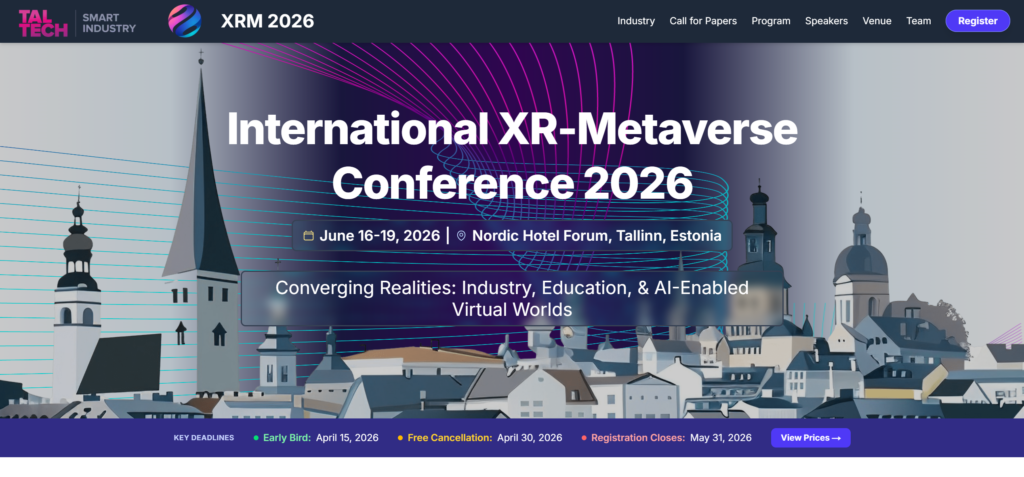
A paper centred on the Immersion Intensity and Plasticity Scale (IIPS) has been accepted for presentation at the International XR-Metaverse Conference 2026 in Tallinn, Estonia, scheduled for 17–19 June 2026.
The IIPS framework emerges from the same line of inquiry as the practical work, seeking to articulate the conditions under which immersive environments modulate attention, affect, and perception. While the framework is formally expressed in the paper, its origins lie in iterative engagement with immersive environments, where recurring dimensions of experience—such as envelopment, pacing, threshold, and reintegration—become perceptible through practice.
STATE-CHANGE TECHNOLOGY: AN IMMERSION INTENSITY AND PLASTICITY SCALE FOR EMERGING GENERATIVE XR
Accepted for SCOPUS Indexed “Springer Proceedings in Business and Economics” International XR-Metaverse Conference 2026
Editor: Professor Timothy Jung, MMU.
Abstract: Emerging extended reality (XR) and artificial intelligence (AI) systems constitute a disruptive inflection point in art and media: platforms can iteratively model perceiver responses and dynamically reconfigure perceptual input. We address an upstream educational and governance gap: artists, developers, and curators lack a shared, auditable vocabulary for describing immersive leverage and proportionate safeguards in bioadaptive generative work. We situate generative XR within an ‘archaeo‑futurist’ framework that reads contemporary immersive art alongside ritual architecture, sacred ceremony, and historical spectacle. We then specify two coupled mechanism families—capture potential (supernormal stimulation and prediction‑error‑rich reinforcement) and plasticity potential (awe‑linked accommodation windows)—and argue that dual‑use risk rises sharply where systems combine both. We propose an Immersion Intensity & Plasticity Scale (IIPS‑8+X) as a platform‑neutral diagnostic instrument, provide an arts‑facing scoring protocol (Maker vs Audience signatures, range reporting for adaptive works), and demonstrate applicability through a structured artefact case study and worked comparative examples. Finally, we instantiate a governance matrix mapping each IIPS dimension to specific, implementable safeguards for curatorial and production practice.
Feedback / Peer Exchange
Feedback is being gathered through informal encounters with trusted viewers (friends and close contacts) rather than formalised user studies. These early viewings function as a preliminary testing ground for how the environments are received at the level of perception and attention.
I have been introducing a ‘light-touch’ form of questioning, informed by existing research on awe and immersive experience (e.g. Chirico et al.; Keltner and Haidt). Rather than administering formalised scales, experiencers are asked open but directed questions concerning perceived scale, disorientation, emotional tone, and whether the experience produces any sense of shift in perspective or self-relation.
At this stage, the aim is not ‘measurement’, but to develop sensitivity to how conditions associated with awe -such as percieved vastness and accommodation – impact the subject, and how I can investigate how better to ‘hold’ the experience through design and threshold conditions. A lot of the information I glean is through observation of immediate body language and physical response, rather than words.
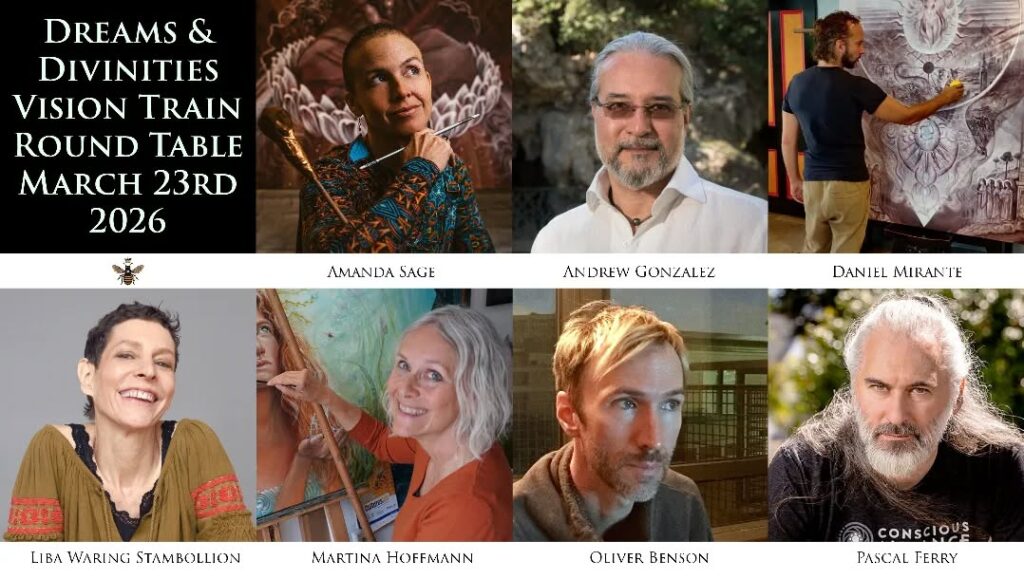
VISION TRAIN – DREAMS & DIVINITIES ROUND TABLE
I presented on www.visiontrain.com with some traditional art luminaries on the nature of creative process and detailed the fusion of archaic and futurism in my process.
Next Steps
Refine the perceptual stability and symbolic coherence of the environments, particularly through improving the quality of 360° generation and the integration of Gaussian splat scenes with video sequences. Attention will be given to how visual continuity, scale, and pacing sustain or disrupt immersion across longer durations. Begin early exploration of live-action compositing within these environments.
Footnotes
- Victor Turner, The Ritual Process (1969).
- Dacher Keltner and Jonathan Haidt, “Approaching Awe” (2003).
- Susan Leigh Star, “The Ethnography of Infrastructure” (1999).
Bibliography
Grau, Oliver. Virtual Art: From Illusion to Immersion. MIT Press, 2003.
Turner, Victor. The Ritual Process. Aldine, 1969.
Keltner, D., and J. Haidt. “Approaching Awe.” Cognition and Emotion 17, no. 2 (2003): 297–314.
Chirico, A., and D. B. Yaden. “Awe.” Current Opinion in Psychology (2022).
Latour, Bruno. Pandora’s Hope. Harvard University Press, 1999.
Star, Susan Leigh. “The Ethnography of Infrastructure.” American Behavioral Scientist (1999).
Tags: #immersivemedia #practicebasedresearch #VR #awe #ritualaesthetics #spatialaudio #worldbuilding #doctoralresearch