
Babylon, the great city, or Babylon the Great. All the cities of the world are brought together in her, she is the synthesis of them all. She is the head and the standard for the other cities. When the wrath of God is loosed, she is struck first. When she is struck, all the other cities are struck in here. Business operates for the city, industry is developed for the city, ships ply the seas for the city, luxury and beauty blossoms forth in the city, power rises and becomes great in the city. She is the one struck in war, and she is the first to be struck in the war between the Lord and the powers of the world.
Jacques Ellul, The Meaning of the City.
Part 1
On the Great Tower
‘O I Beheld the Lost Began to Habitate A Peculiar and Very Spacious Tower.
’ for to Hide Away .. A’ from the Tree of Righteousness And to Mock Those Who Shall Live Upon
His Power.’
It has been said that humans were naked tho’ without ‘shame’ in the Garden. Nakedness is the primordial, divine condition. After entering into the realm of duality, Eve’s son Cain fled from God’s face, after killing his brother Abel, and built the first city through which he could cover himself, pursue survival upon the principles of matter alone. With the city comes slavery, and a division from an intimacy and wisdom of Gods natural law.
Babylon, the fallen city. The “Tower of Babel” has symbolised the error of pride throughout history, representing defection from nature, exploitation of humanity, and the hubris of an earthy rulership against the Sacred. “God has no right to choose the upper world for Himself, and to leave the lower world to us; therefore we will build us a tower, with an idol on the top holding a sword, so that it may appear as if it intended to war with God” (Gen. R. xxxviii. 7; Tan., ed. Buber, Noah, xxvii. et seq.).
In ancient times, people thought the heavens were not far above the earth. If they, the kings, and their archonic rulers, could build a tower to the sky, they could storm heaven. “And they said, “Come, let us build ourselves a city, and a tower whose top is in the heavens; let us make a name for ourselves”. By acquiring ‘true names’, they would become like Gods. But God strikes the ziggurat and scattered the people, dealing the hierarchies responsible for the tower a crushing blow. The archaic image of the tower represents the raising up of a partition between the ego and the totality of consciousness, wherein then the small self may gather up its illusionary existence in an act of consolidated pride. It represents such a process occurring on a vast, collective level – where the face of the earth itself, and the body of humanity, is transformed according to a new, strange order.
And as humans construct the city, they begin to serve the needs of the city, like cells within a new body. Life becomes patterned by sedimentary layers of artifice-based routines, rituals of trade, status, glamour and power. ‘Towers’ evolve ‘bottom up’ in the city, shell-like bodies of Gods, crystalised from daily rituals in honour of these idols.
Part 2
The Realm of Shells
‘And I Beheld a Great and ‘O a Darkening Mist Deviating and Distorting Humankind.
And I Beheld .. that many by da’ Truth to Forsake Lost Their Way in Disobedience and Pride.’
As a shell protects a nut, or a peel protects the fruit, souls are en-veiled, These formative ‘shells’ compose the intermediate developmental forms through which the divine spark develops agency and capacity for sub-creation.
The process of enshelling has been called ‘Tzimtzum’ (Hebrew צמצום ṣimṣūm “contraction/constriction/ condensation/withdrawal”) in the Kabbalah teaching of Isaac Luria. In his doctrine, God began the process of creation by “contracting” his infinite light in order to allow for a “space” in which finite and seemingly independent realms could exist.
Such ‘partitioning’, ‘images’ or’ condensation’ of Pure Light, works “to conceal from created beings the activating force within them, enabling them to exist as tangible entities, instead of being utterly nullified within their source”. It is a way for the soul to develop intelligence and definition within boundless spirit.
When ripened through grace and rigour, the shell will drop from the precious element it has served to protect, and the divine spark is released from limitation, to survive in Eternity. This is how the Divine creates ‘child-Gods’ within its Clear Light.
There is a challenge and a threat in the experience. Divinity invests its divine ‘imagination’ in subcreations, as formative vessels of soul development. The divine sub-creations are endowed with powers of ‘free will’ – choice and creativity.
Under the play of the physical senses, the soul perceives outward into the world of vessels. In this situation, the divine imagination can identify entirely with this realm, and become ‘image-fixed’ upon the samsaric experience – identified with the shell rather than the treasure it houses. Although the body is a temple, this is where the shells or vessels are synonymous with idolatry, for one does not worship the temple itself, but what it houses, and is built in praise of.
The soul may invest in steadily denser planes of experience, which upon, can occupy an entire incarnational experience, until the vessel shatters, and a new abiding, built upon the habits of the past, is developed. This is how we build our own ‘towers’.
We come to uphold the illusion of separation as a fact, and collude with other beings wandering through labyrinths of externalised illusion, to build great walls and towers against what becomes ‘The Other’. The presence of God then becomes a confrontational experience, full of awe and numinous fear, threatening our conventional boundaries. The experience of our finite ‘creature-consciousness’ in the face of Eternity can become something we avoid, retreat from, even defend ourselves from.
This is the ‘shame’ in Eden, shame in Aramaic is ‘boch’, which is connotative of dispersion. From Greek, ‘shame’ is translated into English from the word “entropen” from “entrope”, which literally means “turning-in upon oneself.” It is a ‘fall from paradise’ into a lower dimensional experience, where the numinous presence of divinity is obscured due to the ossification of shells or existential envelopes of the ego consciousness.
Enshellment is cumulative, and various forms of ancestral and collective karma constitute various psychic enshellments that are sustained through our investment and participation over lifetimes. The archons, the ‘rulers’, and physicality itself, are like cosmic enshellment, or, like loops of time, habit, form, experience, to be transcended. We must treat these dense material enshellments as formative matrix’ to be hatched out from. We must not stagnate in old shells !
Part 3
Idols – The Archonic Image
‘O I Beheld the Lost Began to Habitate A Peculiar and Very Spacious Tower.
’ for to Hide Away .. A’ from the Tree of Righteousness
And to Mock Those Who Shall Live Upon His Power.’
Archonic towers use the energy of the entrapped souls to build their empires of vanity taller. They are not simply passive. The archonic forces use desires and fears to stoke energies to feed upon, and lie that there is nothing beyond the enshelled realms. To the theists they show fearsome and punative Godlike appearances, and for the atheists they will colour the view from the tower through the stained glass of hopeless nilihilism and existential despair.
The towers are haunted by false-idols animated into half life. They are dependent on the derivative light of the Soul to shine, i.e they are Lunar. And they seek to master their own creators to achieve a perpetual power-source for continuation of their existence. Many human-made gods and goddesses are such agencies, but they also exist through the names of cultural institutions, ideologies, corporations.
It is clear that commercial transhumanism is first undertaken primarily through an imagery, a symbolic system, a story that emphasises a desacralised cosmos, a hostile nature, a dualistic notion of mind and matter, chords of exile, illness, futility and death. Such fears are then answered with ‘solutions’ that require further and further alteration from the natural world and the naturally created image of humanity.
As this process continues, further decisions and motivations occur from the platform of this altered state. In this scenario of the prospect of ever denser enshellment, the human form itself become remoulded
to the image and ideals of lesser gods and archons. As Tolkien says about the creation of the Orcs from the torture of the Elves, “The Shadow that bred them can only mock, it cannot make: not real new things of its own.”
Part 4
The Rod
‘O I Beheld a Straight and ‘O a Narrow Way Leading to Da’ Holy Tree Of Life.
And ‘O da’ Rod of Iron .. the Holy Testament Of Truth Of da’ Word Of God and Power of da’ Light.
O for da’ Rod Of God .. Uphold da’ Testament It is the Rod within the Covenant Of Life.
For by the Rod .. the Righteous May Partake of His Fruit In the Living Holy Waters of His Light.’
When the intelligence becomes waylaid on its path, where false motives take control, where spiritual blindness causes attachment to enshelled form, the Divine will intervene through Grace or Rigor. As the french traditionalist and sufi Rene Guenon wrote “However far the “solidification” of the sensible world may have gone, it can never be carried so far as to turn the world into a “closed system” such as is imagined by the materialists.” – Though we lived veiled from oneness in the dreaming of duality, higher forces work constantly to dissolve the walls we build within ourselves and between each other.
Tolkien said “I will now bow before the Iron crown, nor put my own small golden sceptre down”. The golden septre that Tolkien refered to, the rod, refers to our gift to create alongside our creator. The rod refers to our divine will, creative power, and the dignity we possess through being made in the image of the divine.
Chanting down the tower is comprised of a prayer for salvation, liberation, freedom. Prayer affirms the mind as an open-system, rather than a hermetic box. Prayer is the creation of a communication pointed to other than talking-to-oneself. Prayer breaks the cycle of inner rumination and discursiveness because it impeaches higher powers for intercession, and it runs on the predicate that the Absolute, being that which by definition comprises all and everything, utterly transcendent of our pedestrian human concepts of ‘inner’ and ‘outer’, is responsive to prayer. “Every hair of your head is numbered, therefore you shall not be afraid” – Luke 12:7
It may not be that the circumstances of natural law are altered for our convenience. It may not be that we can save another – or ourselves from the fruits of their own actions. Because there is dignity in consequences. A sufi said ‘Prayer is always answered, and sometimes the answer is no!’ But the state of whom is praying is changed. We may not know what or whom to implore, because we live deep in the tower and have known little else. But the call is made.
The call is active – from this place creating in the divine Image, the world is expressed and reformed through the hieratic will, through prayer, and through grace. The shattered universe of shells itself becomes a living veil of grace, because it was never separate from the Great Love. In the vast cosmic infinities of emanation, all that exists, no matter how twisted in mockery, can never escape this love truly, though form may conspire to turn its back and indulge its limitation, to be spared from the action of this sacrificial universe, where the burnt offerings of form and density and the sufferance of limit self-liberate into the luminous subtle pleroma as clear perfumed vapour rising to heaven.
Part 5
Sophia
‘O I Beheld a River of His Living Love Flowing as a Fountain of His Truth.
And I Beheld the Fruit .. the Holy Purity There of For da’ Nourishment within His Fruit Is Good.
The earth is a living testament, like a book, who’s pages are the aeons of history. The organic pattern of history explicates from seed and nut into frond, bough, leaf, tree.
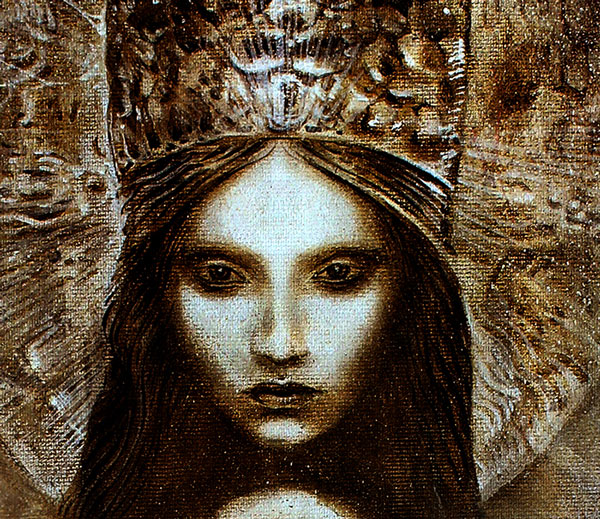
The tree takes different branches and pathways, and upon its branches fly the eagles and subtle birds of winged thought, “angelic” powers that belong to an immortal tradition – the language of the birds, the mysterious patterns of the hidden prime, the conveyors of the inspiration of gnosis. The image of woman crowns this creation, Sophia, the White Cedar, unveiling, seizing the rod of sovereign creativity.
“I am the honoured one and the scorned one.” For as she is enthroned upon the tree of life, she also laments, chained in the towers of the archons, “I am the whore and the holy one.” She sells herself on the pavilions, and even the upper holy chambers of the ziggurat; “I am she whose wedding is great, and I have not taken a husband.” initiating archonic powers to the sacrificial universe in the sovereign syllables of her love cry, the cthonic vowel utterances of female ecstasy. “I am the voice whose sound is manifold, and the word whose appearance is multiple. I am the utterance of my name.”
The tower becomes an ornament of wisdom-mind, and she the pearl within this oyster. “I am she who cries out, and I am cast forth upon the face of the earth.” In seismic tremor, vast cascades of the tower fall to earth as it is simultaneously re-built. “Why, you who hate me, do you love me, and hate those who love me?” The great capstones and minarets and golden heads of great kings fall to the ground to kiss the Earth.
On the periphery of the Tower, the lion headed serpent, the architect, bites down upon its own tail, roused to blood fury by the taste of its own flesh, begetting itself in self-incest, a recursive loop of self-aggrandizement, experiencing primal fear at the unveiling of Sophia-Wisdom. And she councils:
“I am the one whom you have hidden from,
and you appear to me.
But whenever you hide yourselves,
I myself will appear.
For whenever you appear,
I myself will hide from you.”
From this axial place, the waters of life flow from the root-elements, the most fundamental expression of the humility of Sophia. She flows through the earth, always sublimely beautiful, passive poetry to the amorous cling of gravity, pulling her toward invisible centres. And by primal tongues of fire, licked into vapour, steam and air, to sacrifice herself in an everlasting gifting through the rain and the jewels of morning dew, which will bring the desert into new life.